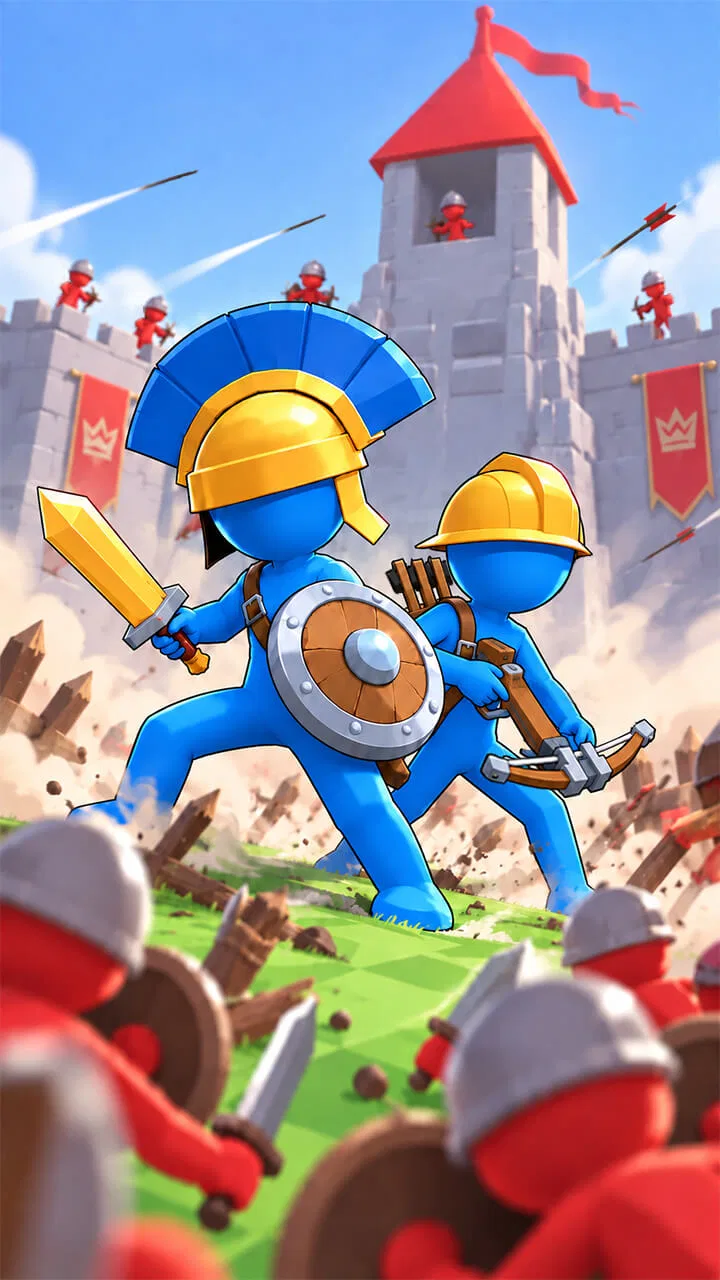
Battle Simulator: Merge Master
- 3.5
- Rating
- 100.00K
- Installs
- Free
- Price

 Analysis by App-foxy
Battle Simulator: Merge Master is a strategy game built around a simple idea: arrange your forces, protect your territory, and try to outplay the opposing side. I found the appeal easy to understand within the first few sessions. It is the kind of game I can open when I want a short tactical distraction rather than a long story, a complicated role-playing system, or a competitive match that demands constant attention.
The game comes from Deli ventures and is free to download. It has reached over 100K installs, which suggests that its straightforward battle-simulation concept has found an audience. Its average score is 3.6 from around two dozen ratings, so I would describe the reception as mixed but promising rather than universally enthusiastic. That feels fair: the basic idea is accessible, while the experience may depend heavily on whether you enjoy experimenting with battlefield choices and repeating attempts until a better arrangement works.
Getting into the first battles without unnecessary frustration
The first place I would expect many players to get stuck is not the broad objective, but the transition from watching a battle unfold to understanding why it went badly. A failed attempt can feel unclear if I focus only on the final result. The useful habit is to treat each round as a small test. I look at which part of my formation collapsed first, whether my units were exposed too early, and whether I committed too much strength to one side.
You May Also Like

 Blood Strike: 2.5 Anniversary
Blood Strike’s Loadouts Turn Every Drop Into a Tactical Gamble
A close look at Blood Strike’s custom loadouts: how fast access to signature weapons reshapes its battle royale rhythm, rewards preparation, and narrows the gap between fights.

 Pandora - Music & Podcasts
Pandora’s Music Is Easy to Start, but Harder to Recover
Pandora’s strength is its low-effort path from a seed to a station. Its weak spot is how much confidence it asks you to place in connection, setup, and quiet recovery.

 8 Ball Pool
 Is Built on Rivalries, Rematches, and Routine
A close look at the rivalries, rematches, shared routines, and unanswered safety questions that turn a quick pool match into a persistent mobile community.

 Samsung Music
’s Quiet Strength Is Playing What You Already Own
Its reach comes less from spectacle than from dependable access to a personal library. That simplicity is both the app’s strongest retention engine and its ceiling.

 AccuWeather: Weather Radar
AccuWeather Review: A Quick, Clear Forecast for Everyday Decisions
For everyday plans, the best forecast is the one you can understand quickly. AccuWeather makes rain timing, radar, and local conditions easy to act on, with a few trade-offs.

 Hill Climb Racing
Why Hill Climb Racing Still Turns Crashes Into One More Run
A tiny car, a bumpy hill and one more upgrade: Hill Climb Racing keeps resurfacing because its simple chaos makes every near-miss feel personal.
More From Our News Desk
View All News


That approach matters because a battle simulator rewards observation more than frantic tapping. When I simply repeat the same setup, I usually get the same weakness with a slightly different outcome. When I change one decision at a time, the game becomes easier to read. I can tell whether the problem is poor positioning, an imbalance in my force, or an opponent that requires a different response.
The word “merge” in the title also sets an expectation that combining or improving forces is important to the experience. I would not approach it like a traditional action game where quick reactions are the main skill. The better mindset is to pause before committing, inspect what is available, and make a deliberate adjustment. Players who enjoy making small tactical corrections should find more here than players who want constant movement.
One practical tip is to avoid changing every choice after a defeat. I prefer to keep the general arrangement and alter the most obvious weak point first. If the front line disappears immediately, I strengthen that area before changing everything else. If the center holds but the edges fail, I adjust the outer positions instead. This creates a clearer connection between the decision and the result.
Another useful habit is to give a new arrangement a fair test instead of judging it from the first few seconds. Some strategies may look weak at the beginning but become effective once the opposing force reaches them. Others appear impressive early and then collapse because they lack depth. Watching the entire encounter, when possible, gives me better information than reacting to the opening exchange alone.
What to check before blaming the game
Because this is a mobile game, setup friction can come from the device rather than the battle itself. Before deciding that a round is broken, I would close other demanding apps, confirm that the device is running a compatible Android release, and restart the game if menus or transitions behave strangely. The listed minimum operating system is Android 8.0, so older software below that requirement is not a sensible environment for troubleshooting.
I also recommend checking whether the game has been updated before spending time on repeated fixes. The current version is 1.1.7, and using an older installation can create behavior that another player does not see. A normal update check is a reasonable first step because it is simple, safe, and does not require changing system settings or deleting personal data.
If the game opens but a battle does not respond properly, I would first leave the round and relaunch it rather than repeatedly tapping the same control. Mobile interfaces can occasionally stop registering input after a transition, especially when the device is busy. A clean restart can separate a temporary interface problem from a genuine strategy mistake.
Storage pressure is another everyday cause of trouble. Even when a game itself is not large, a phone with almost no free space can behave unpredictably during updates or temporary loading. I would make room through ordinary device maintenance, then try again. I would not recommend installing unofficial modified versions or downloading files from unknown sources to solve a problem; that introduces more risk than it removes.
Players should also consider the age classification. Battle Simulator: Merge Master is rated Teen, so it is not presented as a game specifically designed for very young children. That does not automatically make it unsuitable for every family, but parents should use the device’s normal supervision tools and decide whether the game fits the child using the phone.
A recovery routine that keeps progress manageable
When a session starts going poorly, my preferred recovery workflow is deliberately simple. I stop making random changes, note the first visible failure, restart the attempt if necessary, and alter one part of the setup. This is more efficient than rebuilding the entire force after every loss. It also helps reveal whether the difficulty comes from the chosen arrangement or from misunderstanding the available options.
If the game appears frozen during a transition, I would wait briefly, avoid pressing the same control repeatedly, and then restart the app if nothing changes. If the issue returns immediately, I would check the operating system requirement and version status before trying more invasive steps. Clearing app data or reinstalling can remove local information, so I would treat those actions as a last resort and only use them when I understand what may be lost.
A useful everyday scenario is a short break between errands. I can play a few battles, notice that one formation is consistently failing, and use the next attempt to test a focused change. That makes the session feel purposeful even when I do not win every round. It is a better fit for this game than opening it while distracted by several notifications and then assuming the controls or strategy are at fault.
For a longer session, I would keep a mental record of successful patterns rather than relying on luck. I pay attention to which combinations survive longer, which placements protect the vulnerable side, and whether merging produces a meaningful improvement in the current situation. Even without turning the game into a spreadsheet exercise, remembering one or two reliable principles makes later attempts less repetitive.
The trade-off is that this recovery style asks for patience. If I want a game to explain every loss clearly or provide a detailed tutorial for each tactical choice, the experience may feel too opaque. The game’s attraction comes from trying, observing, and adjusting, but that also means some learning is left to the player. I see that as part of the appeal, although it can be a barrier for anyone who dislikes trial and error.
When the problem is outside the app
Not every poor session indicates a defect. A phone running low on battery, overheating, or switching aggressively between apps can make any game feel sluggish. I would test the game after closing background apps and letting the device cool down. If it behaves normally then, the phone’s current condition was probably contributing to the problem.
Input issues can also come from the screen itself. If taps fail in other applications, the right response is device troubleshooting rather than changing the battle strategy. Cleaning the display, removing an obstructive case or protector temporarily, and testing ordinary touch controls can help identify whether the game is actually responsible.
Network conditions may matter during installation, updating, or any part of the experience that depends on loading. If the game cannot update, I would switch between a reliable connection and another trusted network, then retry through the normal app store process. I would avoid treating a failed download as evidence that the game’s battles are malfunctioning.
Notifications and interruptions are easy to overlook. A call, message, screen lock, or battery-saving mode can interrupt a short tactical session and leave the player unsure whether a choice was registered. I prefer to play with interruptions reduced when I am testing a new formation. That does not improve the game’s underlying mechanics, but it produces a fairer impression of how the controls respond.
There is also a difference between a design limitation and a technical failure. If the game gives me little explanation for a defeat, that may be part of its lightweight format rather than something a restart will fix. If a control repeatedly refuses to respond while the rest of the device works normally, that is more likely to be a genuine issue. Keeping those two cases separate prevents wasted troubleshooting.
How it compares with familiar strategy alternatives
Compared with large strategy games featuring campaigns, extensive resource systems, or online clans, this title is easier to approach. I do not need to commit to a long narrative or learn a large collection of menus before making a first tactical decision. That simplicity is its strongest advantage for casual players who want a battle-focused experience without the overhead of a full strategy platform.
On the other hand, players who enjoy deep economic planning may find it limited. A larger strategy alternative usually offers more ways to recover from a bad decision, more long-term goals, and more room for specialized play styles. If I want diplomacy, base construction, detailed technology paths, or a persistent competitive community, I would look elsewhere.
It also differs from fast action games. Here, the satisfaction comes from arranging and evaluating rather than controlling every movement in real time. Someone who enjoys direct reflex challenges may find the pace too passive. Someone who likes testing a setup, watching the result, and refining the next attempt may appreciate the calmer structure.
The free price lowers the barrier to trying it, but it does not guarantee that every player will find enough depth for long-term use. I would recommend treating it as a compact strategy pastime first. If it becomes a regular part of my routine, that will be because the battle experiments remain enjoyable, not because the game replaces a larger strategy title.
Who should try it and who should skip it
I think the game suits players who like simple tactical decisions, short mobile sessions, and the satisfaction of improving a formation through repeated attempts. It is especially suitable for someone who wants to experiment without learning an enormous ruleset. The free entry point also makes it easy to test personally instead of committing money before knowing whether the style fits.
I would be more cautious about recommending it to players who need transparent explanations, extensive tutorials, or a strong sense of long-term progression. Anyone who becomes frustrated when a defeat does not immediately reveal its cause may find the learning curve irritating. Likewise, players looking for a story-driven adventure or a highly reactive action game should choose a different category.
My best advice is to judge it after several thoughtful attempts rather than one rushed round. Use the first session to learn how the battlefield responds, then make controlled changes. If that process feels satisfying, the game has probably found its audience. If it feels like repetition without enough new information, a deeper strategy alternative will likely be a better use of time.
There are also practical expectations around compatibility. The game is intended for Android devices meeting the Android 8.0 minimum, and the installed build should be kept current at version 1.1.7 when possible. Those checks answer the most important setup question before troubleshooting: whether the phone is running a suitable environment in the first place.
My practical verdict after using the battle-simulation format
My main takeaway is that the game works best when I treat each battle as a small tactical experiment. Its territory-defense premise is easy to grasp, and the strategy category is a natural fit for players who enjoy arranging forces and learning from outcomes. Deli ventures keeps the concept approachable enough for casual use, while the merge-focused identity gives the basic simulator a clear angle.
The limitations are equally important. The experience may feel under-explained for players who want every mechanic spelled out, and repeated attempts can become less appealing if the player does not enjoy diagnosing weak formations. Some apparent problems may also come from an outdated installation, an older operating system, low device resources, or interrupted input, so I would complete those basic checks before judging the game harshly.
With an average of 3.6 from around two dozen ratings, I would not present it as a guaranteed favorite. I would present it as a low-commitment option worth trying if you enjoy accessible mobile strategy games and do not mind learning through observation. Its Teen rating and free price make the initial decision straightforward, while the current build gives Android users a clear version target for setup.
In the end, Battle Simulator: Merge Master is most convincing as a quick, experiment-driven strategy game rather than a complete replacement for a major strategy title. I would recommend it to a friend who wants short battles and likes improving a plan one adjustment at a time. I would skip it for someone seeking deep campaigns, rich explanations, or constant action. That is a modest recommendation, but an honest one: when its simple format matches what I want, it provides an enjoyable tactical break without demanding a large time investment.
FAQs for Battle Simulator: Merge Master
01What is Battle Simulator: Merge Master about?
Battle Simulator: Merge Master is a strategic mobile game that combines elements of merging and combat. Players are tasked with merging various units to create stronger characters, which are then used to battle against opposing armies. The game challenges players to think strategically about unit combinations and battlefield tactics.
02Is Battle Simulator: Merge Master free to play?
Yes, Battle Simulator: Merge Master is free to download and play. However, like many free-to-play games, it offers in-app purchases. These purchases can enhance gameplay by providing additional resources or unlocking new units, but they are not necessary to enjoy the core experience of the game.
03What platforms is Battle Simulator: Merge Master available on?
Battle Simulator: Merge Master is available on both Android and iOS platforms. This means you can download and play it on a wide range of smartphones and tablets by visiting the Google Play Store or Apple App Store, ensuring accessibility for most mobile users.
04Does Battle Simulator: Merge Master require an internet connection?
While Battle Simulator: Merge Master can be played offline, certain features may require an internet connection. For instance, accessing in-app purchases, updates, or certain multiplayer elements will need you to be online. However, the core gameplay is accessible without a constant internet connection.
05What age group is Battle Simulator: Merge Master suitable for?
Battle Simulator: Merge Master is generally suitable for players aged 12 and up due to its strategic elements and mild combat themes. The game is designed to be family-friendly, but younger players might need guidance with its strategic aspects and understanding in-app purchases.
Pros
- Engaging and strategic gameplay.
- Easy-to-learn mechanics.
- Visually appealing graphics.
- Frequent updates enhance content.
- Offline mode available.
Cons
- Ads can be intrusive.
- Limited character variety.
- In-app purchases are pricey.
- Occasional performance lags.
- Repetitive sound effects.

Battle Simulator: Merge Master
Gallery